
Why TTR Matters
TTR, also known as prealbumin, is a highly conserved transport protein produced in the liver.1,2
TTR distributes vitamin A and thyroxine throughout the body. It is vital to physiological processes and has a role in supporting cardiac, metabolic, neurologic, and rheumatologic health.1,3-5
TTR Destabilization
TTR destabilization is the root cause of ATTR‑CM.6,7
Factors such as aging or TTR gene variants can trigger a cascade of structural changes that destabilize the configuration of circulating TTR tetramers.6 These changes may cause the tetramers to break apart and misfold.7 Misfolded TTR proteins can aggregate into toxic amyloid fibrils that accumulate throughout the body. In the myocardium, these toxic amyloid fibrils can cause signs and symptoms indicative of transthyretin amyloidosis.7,8
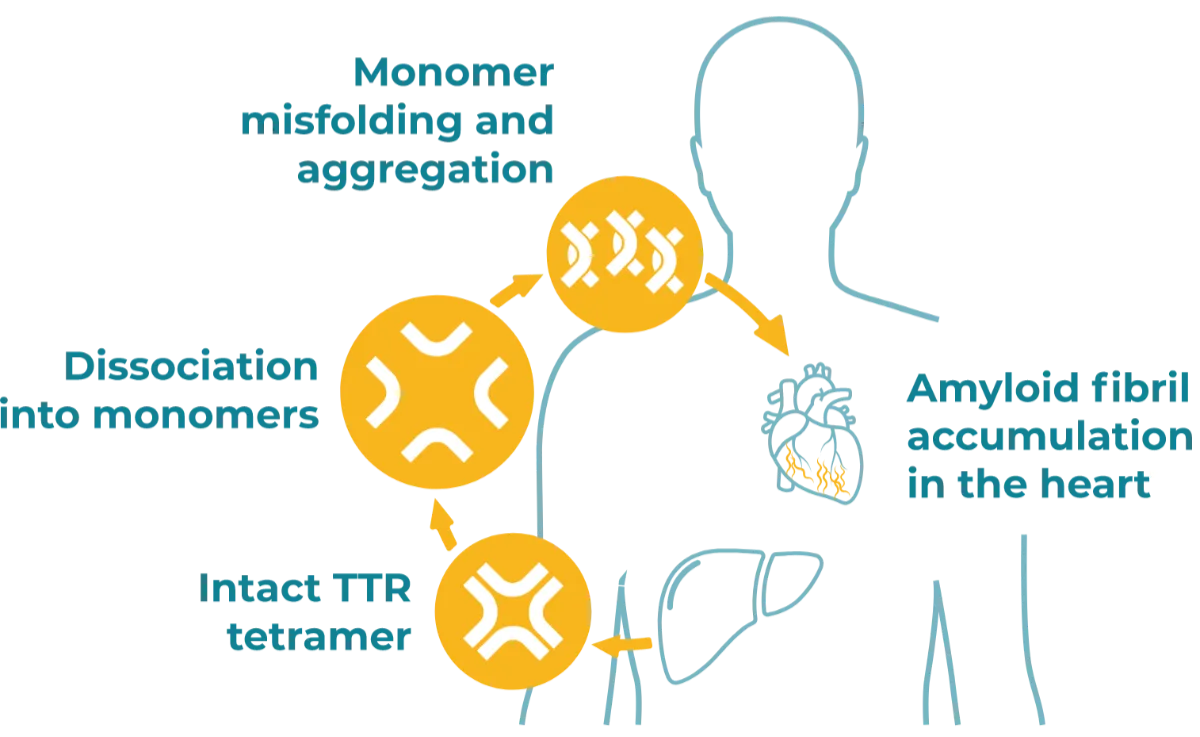
*Amyloid fibrils can also accumulate in areas of the body outside of the heart.6,7
Greater TTR destabilization is correlated with earlier disease onset and severity.9
TTR Stabilization
TTR Stability Impacts Disease
Severity
TTR gene variants strongly influence the rate of TTR tetramer dissociation, which is required for amyloid formation.9 Most known variants destabilize the tetramer, increasing the amyloidogenic potential of TTR and leading to lower serum TTR levels and poor clinical outcomes.5,9
However, variants shown to stabilize the tetramer have also been identified and have been associated with disease protection by preventing amyloidogenesis.8,9 These variants slow the rate of tetramer dissociation which results in higher serum TTR levels. Stabilizing TTR is a therapeutic approach that slows down tetramer dissociation.3,8,9
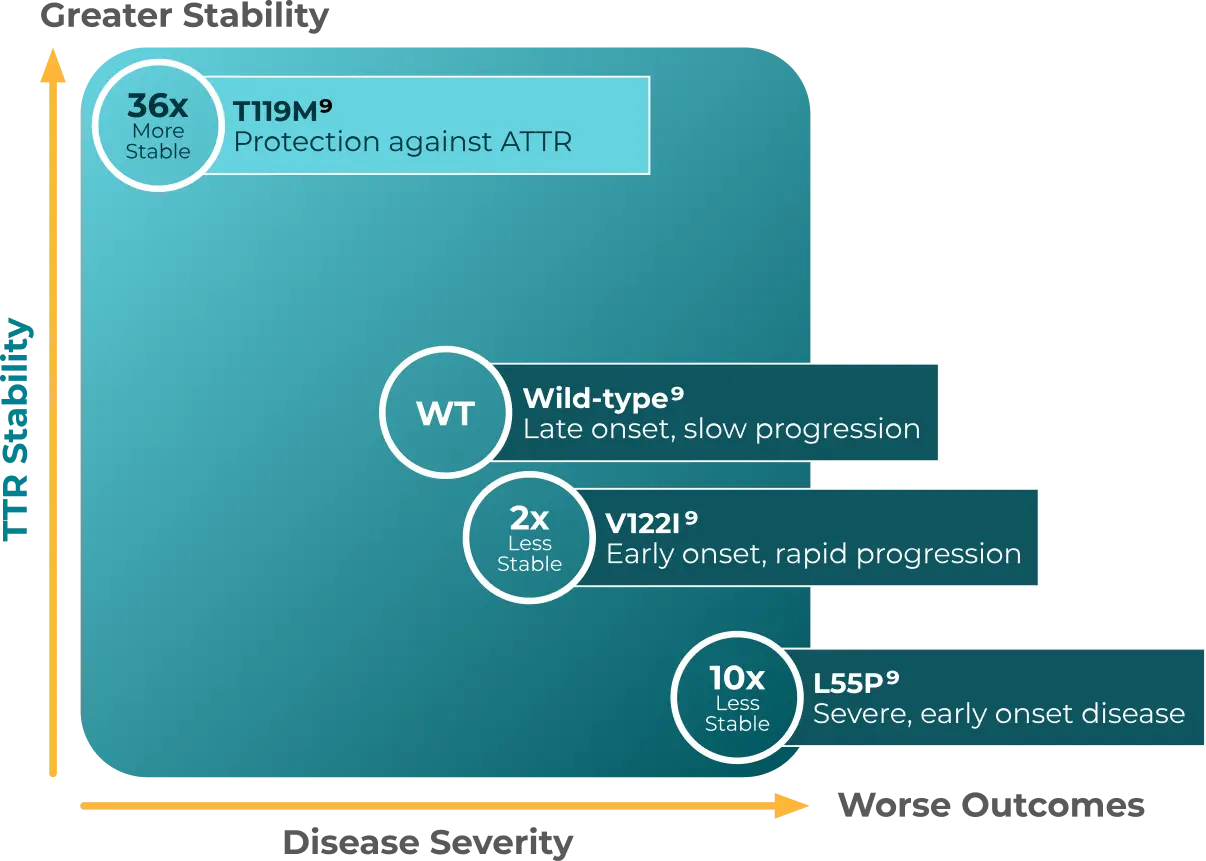
TTR tetramer stability relative to wild-type, determined by denaturation midpoints in an in vitro dissociation/unfolding assay.9
The most beneficial TTR gene variant identified to date is T119M, which has been shown to provide protection against the development of ATTR even when coinherited with variants associated with poor outcomes.9
Explore the latest research on TTR in ATTR‑CM
TTR is a multifunctional protein with vital roles across organ systems. The long-term clinical effects of TTR suppression remain unknown. Ongoing research is essential to assess the long-term impact of TTR suppression.3

Explore the multifunctional role of TTR
Review the differences between wild-type and variant ATTR-CM subtypes.
 ATTR-CM Subtypes

Access patient profiles and compare individual characteristics.
 Patient Profiler Tool
ATTR-CM=transthyretin amyloid cardiomyopathy; TTR=transthyretin; WT=wild-type.


Liz MA, Coelho T, Bellotti V, Fernandez-Arias MI, Mallaina P, Obici L. A narrative review of the role of transthyretin in health and disease. Neurol Ther. 2020;9(2):395-402. 2. Vieira M, Saraiva MJ. Transthyretin: a multifaceted protein. Biomol Concepts. 2014;5(1):45-54. 3. Gertz MA, Aras MA, Bart N, et al. Unravelling the myriad physiologic roles of transthyretin: critical considerations for treating transthyretin amyloidosis. Ann Med. 2025;57(1):2536755. 4. Alemi M, Oliveira Â, Tavares SC, et al. Exploring the physiological role of transthyretin in glucose metabolism in the liver. Int J Mol Sci. 2021;22(11):6073. 5. Wieczorek E, Ożyhar A. Transthyretin: from structural stability to osteoarticular and cardiovascular diseases. Cells. 2021;10(7):1768. 6. Kittleson MM, Maurer MS, Ambardekar AV, et al. Cardiac amyloidosis: evolving diagnosis and management: a scientific statement from the American Heart Association. Circulation. 2020;142(1):e7-e22. 7. Ruberg FL, Grogan M, Hanna M, Kelly JW, Maurer MS. Transthyretin amyloid cardiomyopathy: JACC state-of-the-art review. J Am Coll Cardiol. 2019;73(22):2872-2891. 8. Hornstrup LS, Frikke-Schmidt R, Nordestgaard BG, Tybjaerg-Hansen A. Genetic stabilization of transthyretin, cerebrovascular disease, and life expectancy. Arterioscler Thromb Vasc Biol. 2013;33(6):1441-1447. 9. Hammarström P, Jiang X, Hurshman AR, Powers ET, Kelly JW. Sequence-dependent denaturation energetics: a major determinant in amyloid disease diversity. Proc Natl Acad Sci USA. 2002;99(suppl 4):16427-16432. 10. Morfino P, Aimo A, Vergaro G, et al. Transthyretin stabilizers and seeding inhibitors as therapies for amyloid transthyretin cardiomyopathy. Pharmaceutics. 2023;15(4):1129.
For US Healthcare Professionals
The information provided on this site is intended for use by healthcare professionals practicing in the United States.
By clicking Continue, you confirm you are a healthcare professional practicing in the United States.
Thank you for visiting
TTRMatters.com
If you are a healthcare provider and want to learn more about an ATTR-CM treatment option, click Continue.
To remain on TTRMatters.com, click Stay.
Thank you for visiting TTRMatters.com
You are about to leave TTRMatters.com and visit an external site. BridgeBio is not responsible for the content and privacy practices of the site you're about to redirect to.