
Diagnosing
ATTR‑CM
Early identification and diagnosis can help make a difference for patients with ATTR‑CM by informing treatment decisions.1
Diagnostic Algorithm
A thorough diagnostic approach based on following the appropriate steps is essential for timely identification and effective disease management.1,2
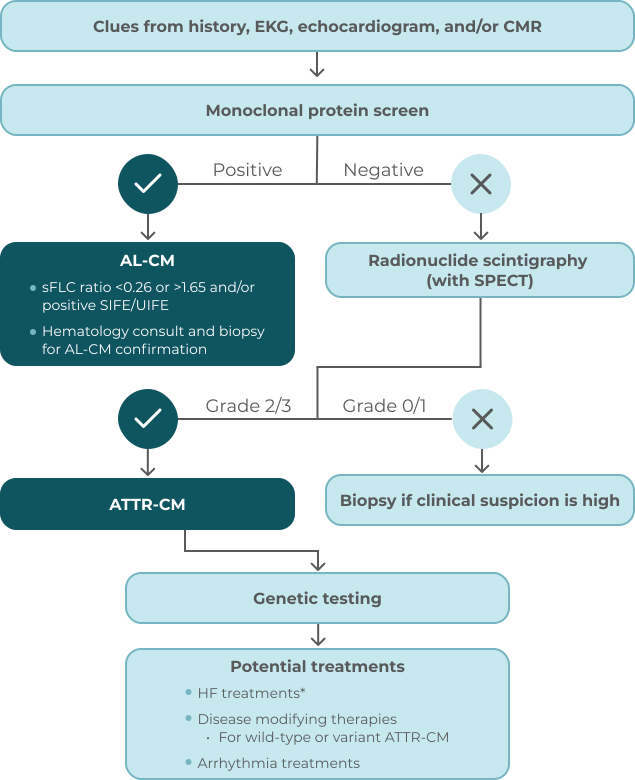
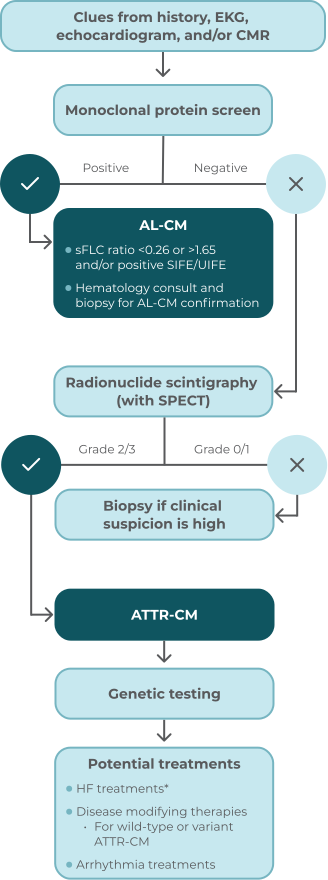
*Renin-angiotensin system inhibitors and beta-blockers should be used cautiously in ATTR‑CM.
Adapted from Kittleson MM, et al. J Am Coll Cardiol. 2026.
Genetic testing and identifying patient subtypes can complement imaging findings and help avoid misdiagnosis.1

Biomarkers
Serum TTR and NT-proBNP (N‑terminal pro–B-type natriuretic peptide) are important predictive biomarkers for cardiac morbidity and mortality in people with ATTR‑CM.3-5
High Serum TTR: An Indicator of Stability
High Levels of Serum TTR Are Associated With Protection Against Heart Failure6
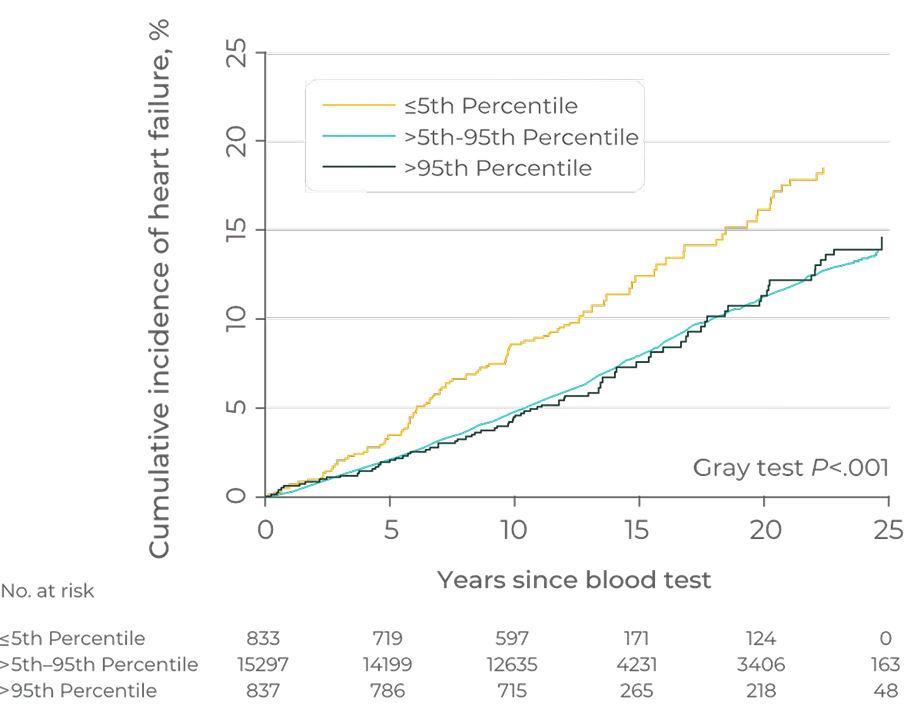
Reproduced with permission from Greve AM, et al. JAMA Cardiol. 2021;6(3):258-266. Copyright© 2021 American Medical Association. All rights reserved.
High Levels of Serum TTR Are Associated With Prolonged Survival3
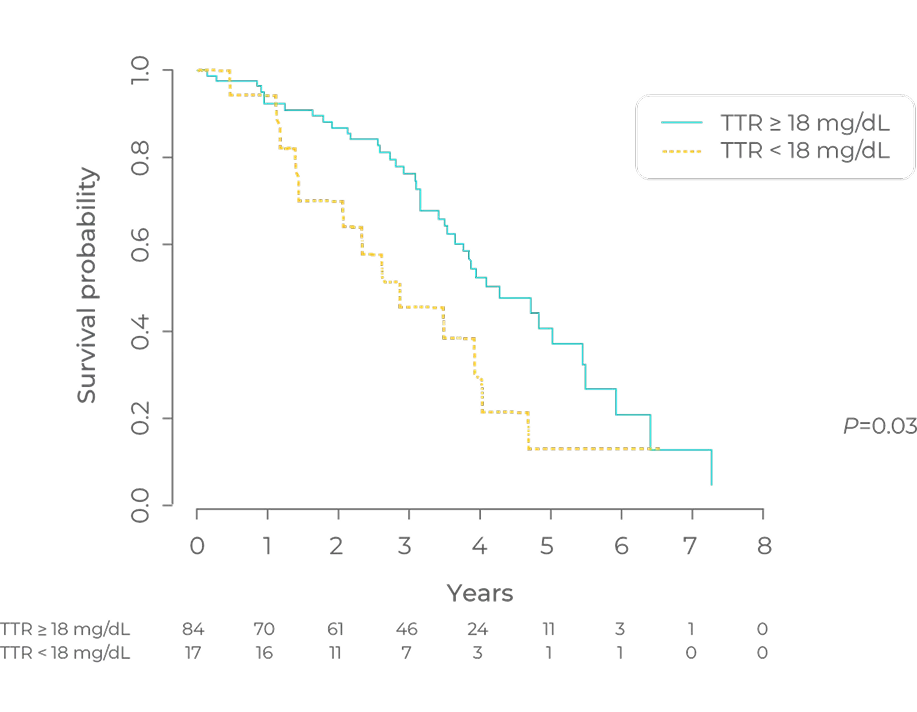
Reproduced with permission from Hanson JLS, et al. Circ Heart Fail. 2018;11(2):e004228.
NT-proBNP: An Indicator of Cardiac Morbidity
- Secreted by the heart in response to stress and pressure overload5
- Measure of worsening heart failure and cardiac dysfunction4,5
12-month Change in NT-proBNP: One of the Only Independent Predictors of ATTR‑CM Mortality4
| Variable | HR (95%CI) | P value |
|---|---|---|
| ∆ NT-proBNP (ng/L)* | 1.05 (1.02–1.07) | 0.001 |
| ∆ eGFR (mL/min) | 1.00 (0.98–1.01) | 0.732 |
| ∆ Albumin (g/L) | 1.01 (0.95–1.06) | 0.840 |
| ∆ Troponin T (ng/L) | 1.01 (1.00–1.02) | 0.055 |
| Increasing NYHA class | 1.72 (1.18–2.52) | 0.005 |
| ∆ 6MWD (m)† | 0.85 (0.70–1.02) | 0.080 |
|
*HR for NT-proBNP is per 500-ng/L increase.
†HR for 6MWD is per 100-m increase. |
||
Decreased NT-proBNP Is Associated With Increased Survival in People With ATTR‑CM4

Adapted from Law S, et al. Heart. 2022;108(6):474-478. Data courtesy of UK National Amyloidosis Centre.
Learn more about how changes in NT-proBNP concentration can be an independent predictor of mortality in ATTRwt‑CM.4
Decreased NT-proBNP Is Associated With Increased Survival in People With ATTR‑CM4
Adapted from Law S, et al. Heart. 2022;108(6):474-478. Data courtesy of UK National Amyloidosis Centre.
Cardiac Imaging
The American Society of Nuclear Cardiology recommends an initial cardiac workup of a clinical examination and EKG if signs and symptoms are suggestive of ATTR‑CM.7 Imaging used to indicate high index of suspicion for ATTR‑CM include echocardiography and cardiac magnetic resonance.7 Light chain amyloidosis can present similarly and must be ruled out via SPIE, UPIE, and SFLC. Cardiac scintigraphy is frequently used to confirm an ATTR‑CM diagnosis.8,9
6MWD=6-minute walk distance; AL-CM=light chain amyloid cardiomyopathy; ATTR-CM=transthyretin amyloid cardiomyopathy; ATTRwt=wild-type transthyretin-mediated amyloidosis; CMR=cardiovascular magnetic resonance; eGFR=estimated glomerular filtration rate; EKG=electrocardiogram; HF=heart failure; HR=hazard ratio; NT-proBNP=N-terminal pro–B-type natriuretic peptide; NYHA=New York Heart Association; SFLC=serum free light chain; SIFE=serum immunofixation electrophoresis; SPECT=single-photon emission computed tomography; SPIE=serum protein electrophoresis with immunofixation; TTR=transthyretin; UIFE=urine immunofixation electrophoresis; UPIE=urine protein electrophoresis with immunofixation.
Patient Profiler Tool
Identify patients with ATTR‑CM in your practice earlier

Explore clinical characteristics and diagnostic work-up of different patients to inform decision making.

Patient Profiler Tool
History
Diagnostic Workup

Tools to Help
Compare other patients

Experts on ATTR‑CM Diagnosis


Rozenbaum MH, Large S, Bhambri R, et al. Impact of delayed diagnosis and misdiagnosis for patients with transthyretin amyloid cardiomyopathy (ATTR-CM): a targeted literature review. Cardiol Ther. 2021;10(1):141-159. 2. Kittleson MM, Ambardekar AV, Cheng RK, et al. Transthyretin cardiac amyloidosis evaluation and management: 2025 ACC concise clinical guidance. J Am Coll Cardiol. 2026;87(5):549-565. 3. Hanson JLS, Arvanitis M, Koch CM, et al. Use of serum transthyretin as a prognostic indicator and predictor of outcome in cardiac amyloid disease associated with wild-type transthyretin. Circ Heart Fail. 2018;11(2):e004000. 4. Law S, Petrie A, Chacko L, et al. Change in N-terminal pro-B-type natriuretic peptide at 1 year predicts mortality in wild-type transthyretin amyloid cardiomyopathy. Heart. 2022;108:474-478. 5. Oghina S, Josse C, Bézard M, et al. Prognostic value of N-terminal pro-brain natriuretic peptide and high-sensitivity troponin T levels in the natural history of transthyretin amyloid cardiomyopathy and their evolution after tafamidis treatment. J Clin Med. 2021;10(21):4868. 6. Greve AM, Christoffersen M, Frikke-Schmidt R, Nordestgaard BG, Tybjærg-Hansen A. Association of low plasma transthyretin concentration with risk of heart failure in the general population. JAMA Cardiol. 2021;6(3):258-266. 7. Dorbala S, Ando Y, Bokhari S, et al. ASNC/AHA/ASE/EANM/HFSA/ISA/SCMR/SNMMI Expert consensus recommendations for multimodality imaging in cardiac amyloidosis: Part 1 of 2-Evidence base and standardized methods of imaging. Circ Cardiovasc Imaging. 2021;14(7):e000029. 8. Witteles RM, Bokhari S, Damy T, et al. Screening for transthyretin amyloid cardiomyopathy in everyday practice. JACC Heart Fail. 2019;7(8):709-716. 9. Ajima T, Aikawa T, Saitou T, et al. Prognostic value of 99mTc-pyrophosphate uptake in patients with suspected transthyretin cardiac amyloidosis. J Nucl Cardiol. 2025;51:102452. 10. Heidenreich PA, Bozkurt B, Aguilar D, et al. 2022 AHA/ACC/HFSA Guideline for the management of heart failure: a report of the American College of Cardiology/American Heart Association Joint Committee on Clinical Practice Guidelines. Circulation. 2022;145(18):e895-e1032. 11. ARUP Laboratories. 0050435. Accessed May 5, 2026. https://ltd.aruplab.com/Tests/Pub/0050435 12. Gillmore JD, Judge DP, Cappelli F, et al. Efficacy and safety of acoramidis in transthyretin amyloid cardiomyopathy [protocol]. N Engl J Med. 2024;390(2):132-142. 13. Data on file. BridgeBio Pharma, Inc.; 2024-2025. 14. Fischer BG, Evans AT. High-sensitivity cardiac troponin algorithms and the value of likelihood ratios. J Gen Intern Med. 2023;38(9):2189-2193. 15. Heidenreich PA, Bozkurt B, Aguilar D, et al; Writing Committee Members. 2022 American College of Cardiology/American Heart Association/Heart Failure Society of America Guideline for the Management of Heart Failure: Executive Summary. J Card Fail. 2022;28(5):810-830. 16. Judge DP, Heitner SB, Falk RH, et al. Transthyretin stabilization by AG10 in symptomatic transthyretin amyloid cardiomyopathy. J Am Coll Cardiol. 2019;74(3):285-295.
For US Healthcare Professionals
The information provided on this site is intended for use by healthcare professionals practicing in the United States.
By clicking Continue, you confirm you are a healthcare professional practicing in the United States.
Thank you for visiting
TTRMatters.com
If you are a healthcare provider and want to learn more about an ATTR-CM treatment option, click Continue.
To remain on TTRMatters.com, click Stay.
Thank you for visiting TTRMatters.com
You are about to leave TTRMatters.com and visit an external site. BridgeBio is not responsible for the content and privacy practices of the site you're about to redirect to.